
Home / Foundation Repair / Wall Shear
Foundation Repair · Wall Shear
Foundation Wall Shear: When Part of the Wall Has Moved
Wall shear is displacement: one section of a basement wall has slid out of line with the section next to it. Here’s what it looks like, why it happens, and why we never treat it as just a crack.
What It Is
What Is Foundation Wall Shear?
A block basement wall is built in courses held together by mortar. When soil pressure outside pushes harder than the wall can resist, the wall can give way along one of those joints: the courses on one side of the joint slide inward past the courses on the other. That offset is wall shear, sometimes called wall displacement.
It is different from a hairline crack. A crack can be a gap in an otherwise straight wall. With shear, the wall itself is no longer in one plane.
What it looks like
- A horizontal crack with a step in it — the block above the joint no longer lines up with the block below.
- A ledge you can feel with your hand, or a straightedge that rocks across the crack instead of lying flat.
- Block courses shifted at the top of the wall, or mortar crushed and crumbling along one joint.
- Doors or windows nearby going out of square.
See the Difference
What Is Happening to the Wall?
Pick what you’re seeing. The drawings show the same block wall two ways: as you’d see it standing in the basement, and cut through from the side.
From inside the basement
Cut through from the side
A sound, plumb wall
Simplified illustration of a concrete block basement wall. Not to scale.
Why It Happens
Why Foundation Walls Shear
The forces are the same ones behind most Quad Cities foundation problems: clay soil that swells when it's wet, water pressure in saturated soil against the wall, and freeze-thaw cycles working on the wall season after season. Soil pushes on every basement wall. When that lateral pressure is more than the wall can carry, the wall moves, and in a block wall the movement usually shows up along the mortar joints. Shear is what it looks like when a section of the wall has slid along one of them.
Water is usually part of the story. When it is, correcting the drainage is part of the repair conversation too, so the pressure that moved the wall doesn't keep building.
Why It Matters
Why Any Measurable Wall Shear Is Serious
- The wall is no longer one piece. Shear means a section has been displaced relative to the rest of the wall. That is structural movement, not a surface defect.
- It doesn't reverse on its own. Wall movement won't fix itself, and it tends to get worse as the same pressure keeps working on it.
- It changes the repair. Displaced or sheared block is one of the main things we weigh when deciding whether a wall can be braced or needs a section rebuilt.
Our position
We treat any measurable offset at a joint as structural movement that needs to be looked at in person, not as a crack to patch and paint over. It may not need a repair today, but only a measurement over time tells you whether a wall is still moving.
Behncke Construction · we diagnose before we prescribe
How We Stabilize It
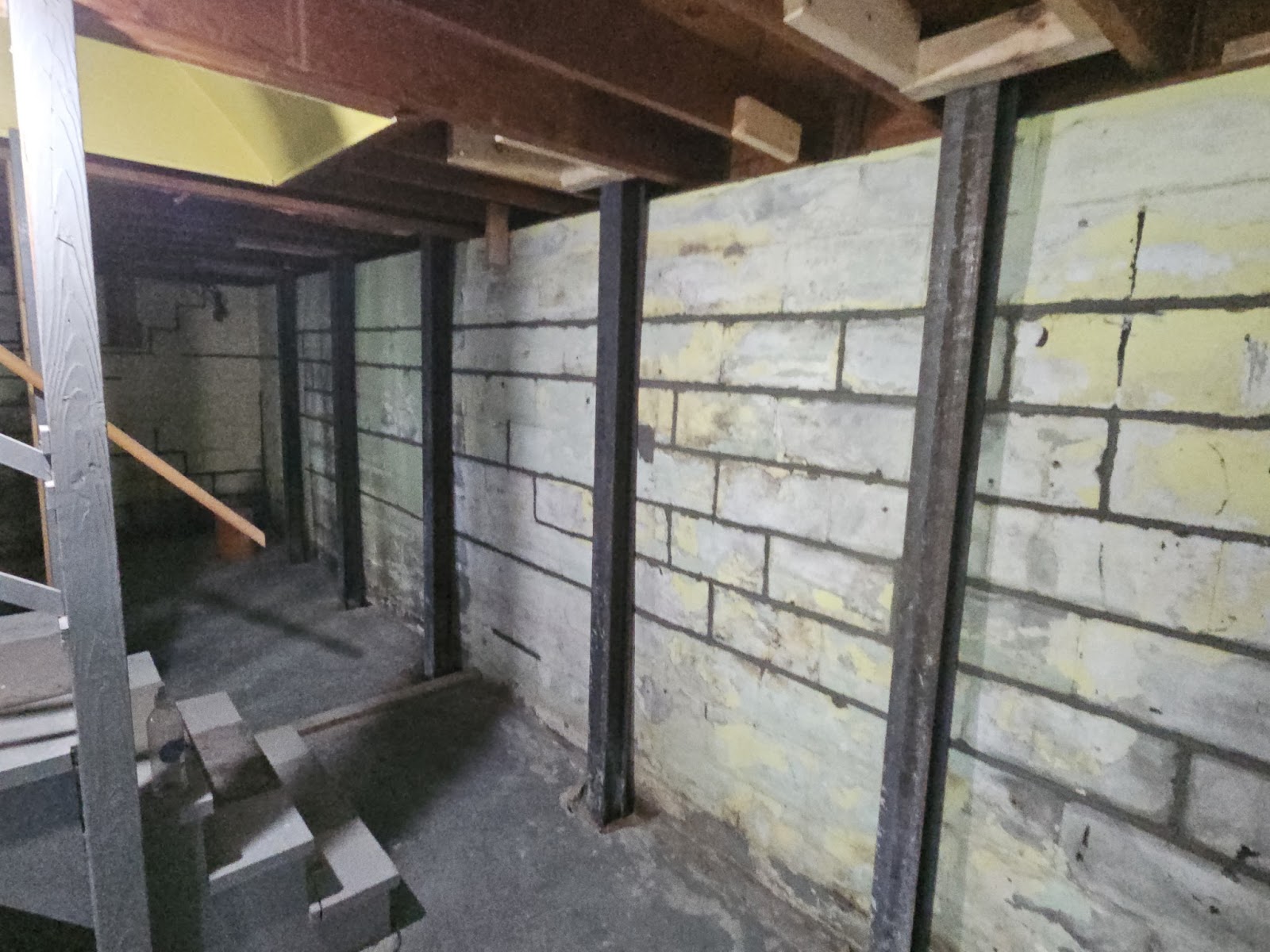
Stabilizing a Sheared Wall With Steel I-Beams
When a sheared wall is still sound enough to hold and bracing will arrest the movement, we stabilize it with our engineered steel I-beam bracing system: a W4×13 structural steel I-beam running essentially the full height of the wall, installed to a standard detail sealed by a licensed Iowa professional engineer. Each brace is engaged with the structure at three places. Step through them:
Simplified illustration, not to scale. Connection details, fastener schedules and beam spacing are not shown; the configuration for each wall is determined on site.
What bracing does, and what it doesn't. The beams restrain continued inward movement and hold the wall where it is. They don't slide a sheared section back into line. If a wall has been displaced or sheared beyond what bracing can safely hold, the right answer is rebuilding that section. Where that line falls is an engineering call, and we make it on site with the wall in front of us. For how we weigh brace versus rebuild on a moving wall, see bowing & leaning basement walls.
Wall Shear Questions
Is wall shear the same as a bowing wall?
No. A bowing wall curves inward, usually around a horizontal crack across the middle of the wall. Shear is displacement: a section of the wall has slid out of line with the section next to it, leaving an offset at the joint. A wall can show both.
Can a sheared wall be braced?
Sometimes. If the wall is still sound and bracing will arrest the movement, we brace it with engineered steel I-beams. If it has been displaced beyond what bracing can safely hold, that section is rebuilt. We make that call on site.
Will the steel beams push the wall back into place?
Bracing is there to stop continued movement and hold the wall where it is. Whether any correction is realistic depends on the wall, and we'll tell you honestly what to expect before any work starts.
Is a small offset really a big deal?
We treat any measurable offset as structural movement worth an in-person look. It may not need a repair today, but it shouldn't be patched over and forgotten. Measuring it over time is what tells us whether it's still moving.
Seeing an offset in your basement wall?
We'll measure it, tell you what moved and why, and whether bracing or rebuilding is the right answer. Free evaluations.
Part of our foundation repair work: see the full range of foundation repair in the Quad Cities, from crack repair to wall bracing and rebuilds.