Home / Foundation Repair / Bowing Walls
Foundation Repair · Bowing Walls
Bowing & Leaning Basement Walls
When a basement wall starts to bow, the real question is brace or rebuild, and most sound walls can be braced. Here’s exactly how we decide, and what it costs.
Based on more than 1,200 written inspections and nearly 10,000 estimates across the Quad Cities in the last ten years.
What’s Happening
Why Basement Walls Bow
A bowing or leaning wall is almost always lateral pressure from the soil outside. Quad Cities clay holds water and expands against the wall, and freeze-thaw cycles add to it season after season. On block and older stone walls, that pressure shows up as a horizontal crack across the middle of the wall and a visible inward bow.
The good news: a wall that is bowing but still structurally sound can usually be braced rather than torn out and rebuilt.
How We Decide
Brace or Rebuild? What We Actually Look At
We separate the structural question from the water question and weigh the evidence before recommending anything:
- Horizontal crack & measured bow — how far the wall has moved. The measurement matters: on a block (CMU) wall there is a point past which bracing alone is not enough and the wall needs to be straightened or partially rebuilt. Where that line falls is an engineering call, and we make it on site with the wall in front of us.
- Floor/slab movement — a stability signal; none is a good sign.
- Displaced or sheared block — movement beyond what bracing can safely hold.
- Active vs. stable — is it still moving?
If the wall is bowing but sound and bracing will arrest the movement, we brace it. We only recommend a rebuild when the wall is displaced beyond what bracing can hold. This follows the principle we apply to every job: the smallest repair that permanently solves the problem.
Myth vs. Fact
Myth: a bowing wall always means a full tear-out and rebuild. Fact: most bowing walls in the Quad Cities are still sound enough to brace with steel I-beams, far less cost and disruption than a rebuild. A rebuild is reserved for walls that have moved past what bracing can safely hold. See all our repair methods →
Behncke Construction · we diagnose before we prescribe
How We Brace It
Steel I-Beam Bracing
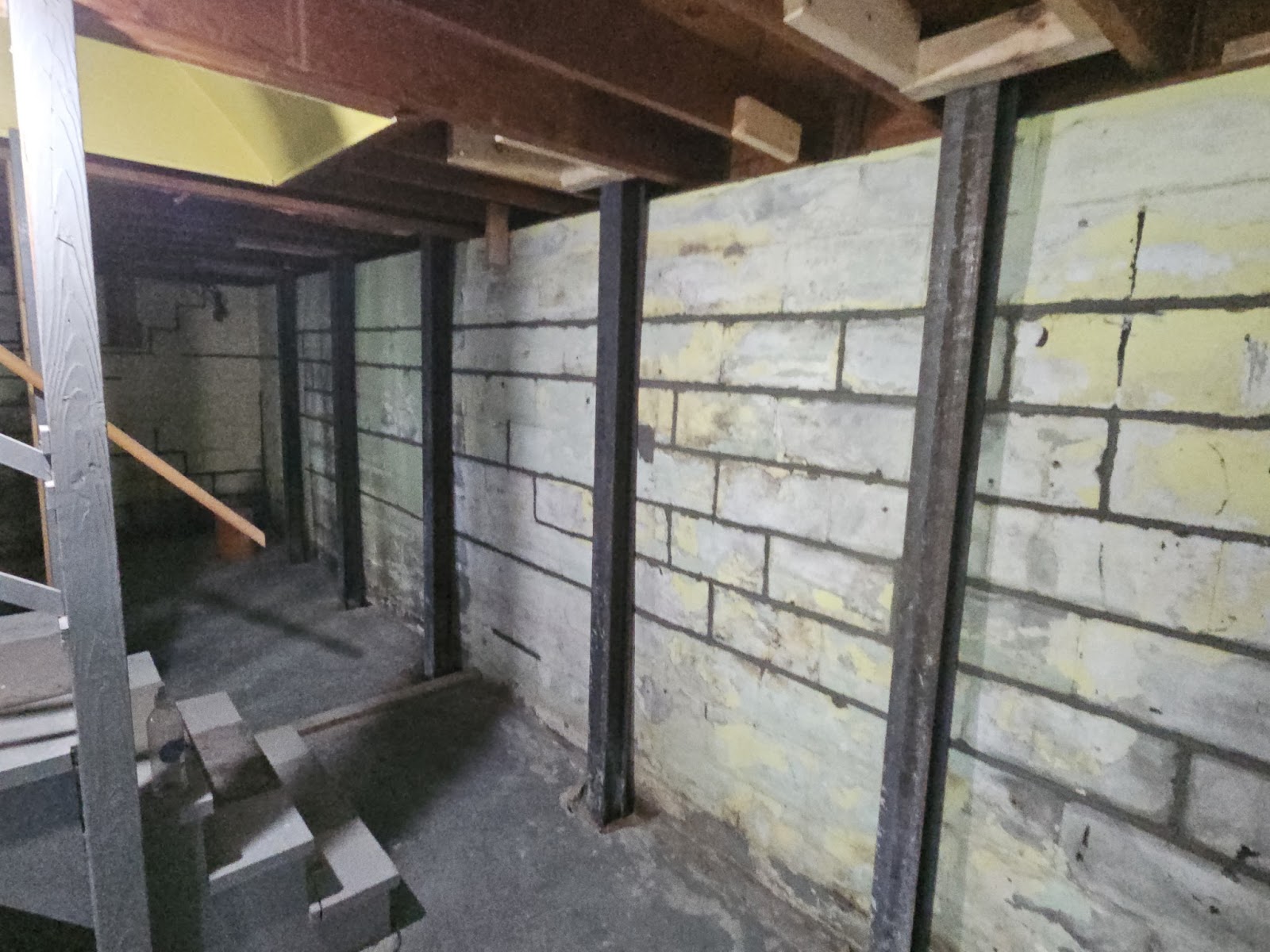
Steel I-beams set vertically against the wall, spaced every 4 to 6 feet, have been our most-used wall-bracing method for decades, the most reliable repair for a wide range of Quad Cities foundations. The beams anchor to the floor and the joists above, brace the wall against further inward movement, and in many cases let us gradually straighten it over time. Typical cost runs about $500–$800 per beam.
When We Rebuild
And When We Don’t
If a wall is displaced or sheared beyond what bracing can safely arrest, the right answer is rebuilding that section, typically $8,000–$25,000 depending on size and access. It’s a bigger job, so we only recommend it when the evidence genuinely calls for it.
What we usually don’t recommend for typical wall movement: wall anchors (we’ve been called to fix anchor jobs that pulled or cracked the wall plate) and helical piers (unnecessary and expensive for most Quad Cities homes). They’re oversold far more often than they’re the right call.
Common Questions
How serious is yours? Look for these.
This won’t tell you the repair, it tells you how urgently to have it looked at.
Bowing-Wall Questions
Is a bowing wall an emergency?
Not always, but it won’t fix itself, and it tends to get worse. We’ll tell you honestly whether it needs action now or can be braced and monitored.
Can you straighten the wall, or just stop it?
Steel I-beam bracing stops further movement, and in many cases the wall can be straightened gradually over time. We’ll tell you what’s realistic for your wall.
Do I need piers or anchors?
For typical Quad Cities wall movement, usually not. We brace with steel I-beams and reserve bigger interventions for walls that truly need them.
Worried about a bowing wall?
We’ll look at it honestly and tell you whether it needs bracing now, no oversized quotes. Free estimates.
Recent projects from our crews
Real bowing and failing walls we stabilized, start to finish.
Keep it protected year after year
Once your basement and foundation are in good shape, the Behncke Annual Basement & Foundation Checkup keeps them that way — a yearly preventive visit that documents conditions and catches small changes early, before they become expensive repairs.
Explore related repairs & solutions
Straight answers, no sales pressure
Bowing & leaning wall questions we hear from Quad Cities homeowners
The questions we get most from Davenport, Bettendorf, Moline, Rock Island, and LeClaire, answered the same way we’d explain them standing at your wall.
My basement wall is bowing or leaning in, can you fix it?
Yes, and the first thing to understand is that bowing is pressure, not age. Something outside is pushing on the wall: saturated clay soil expanding against it, frost, or water with nowhere to go. We stabilize the wall with steel I-beam bracing, usually breaking and re-pouring the floor over the footing so the beams bear properly, and when water is what’s doing the pushing, we pair the fix with drainage so the pressure doesn’t just build right back up. We’ll show you what’s moving and why before we quote a number.
Should I brace the wall or tear it out and replace it?
In most cases, brace it. A full tear-out and rebuild is a much bigger, more expensive job, and we reserve it for walls that are too far gone to save, in our own records, steel bracing outnumbers wall rebuilds several to one. Bracing stabilizes the wall where it stands and stops the movement; rebuilding is the last resort, not the default. We’ll tell you honestly which camp your wall is in, and we won’t talk you into a rebuild you don’t need.
Bowing wall plus water and cracks, I’m buying this home. Can I get a full repair estimate?
Yes, and this is exactly the situation where one honest walk-through pays for itself. Bowing, water, and cracks usually trace back to the same root, water and soil pressure against the wall, so we look at all three together and give you one written estimate you can use in your negotiation or hand to your lender. You’ll see what’s structural, what’s water management, and what it all costs before you’re at the closing table. If part of it is optional or can wait, we’ll say so.
Related guide: Carbon Fiber, Steel Beams, or Rebuild? Why Bowing Walls Don’t Have One Fix.
The system we install: Engineered Steel I-Beam Foundation Wall Bracing — restrained into the framing above, embedded into the concrete floor below, and mortared continuously against the wall.
Been quoted carbon fiber? Read the limitations of carbon-fiber straps before you decide — including when it is genuinely the right call.