
Wood & Floor Repair
Sagging floors and rotted framing in older Quad Cities homes, fixed at the cause.
Sill plates, joists, beams and posts that have given way to a century of moisture and movement. We repair the structure under your floor, and fix the water problem that caused it, so it stays solid.
Serving the Quad Cities since 1948 · Iowa & Illinois · Homes built 1880s–today
Based on more than 1,200 written inspections and nearly 10,000 estimates across the Quad Cities in the last ten years.
What we’ve seen in the fieldA bouncy floor isn’t always a structural problem
Soft, springy floors scare homeowners into expecting the worst. Often it’s less than you think.
Sometimes a bouncy floor is a failing joist or sill plate that needs real repair. Just as often it’s undersized joists, a missing mid-span support, or a beam that has settled, fixable by sistering joists or adding a post and beam, not tearing out the floor. The trick is knowing which is which. We figure out why the floor moves before we decide how much to do about it, and we do the smallest fix that makes it solid. One early tell you can check yourself: kitchen cabinets. Rigid cabinetry is the most sensitive sag gauge in a house — when doors drift out of line or a gap opens between the cabinets and the wall or countertop, the floor under them has started to move.
The Behncke crew · Quad Cities, since 1948
What we’re really fixing
The wood isn’t bad. Something got to it.
A bouncy, sloping or sagging floor is rarely a flooring problem, it’s the framing underneath telling you a beam, joist or post has lost its footing or rotted at the ends. In our older homes that almost always traces back to moisture and time. We fix the structure and the source, not just the symptom.
Quad Cities homes
Old houses, built a certain way.
Davenport, Bettendorf, Rock Island and Moline are full of homes from the late 1800s and early 1900s, built with materials and methods that age in predictable ways. Knowing the house tells us where to look.
Balloon-frame Victorians & foursquares
Tall, full-height studs and dimensional old-growth lumber sitting on sill plates that rot where they meet damp masonry. Beautiful homes, with vulnerable bearing points.
Bungalows & story-and-a-halfs
Often over crawl spaces or shallow basements where humidity, grade and old plumbing leaks go to work on joists and beams for decades.
Limestone & brick-foundation homes
Rubble-stone and soft-brick foundations move with our clay soil and freeze-thaw, shifting the posts and shims that hold the floor framing level.
Free · no obligation
Not sure what your home actually needs?
Tell us what’s going on. We’ll diagnose the real problem and put a written estimate in your hands, usually within one business day. No pressure, no commissioned salespeople.
How older homes settle
What we find under a sagging floor.
After nearly eight decades in these basements and crawl spaces, the same handful of failures show up again and again.
Rotted sill plates
The wood band where the house meets the foundation, decayed where it stayed damp against masonry.
Joist & beam-end rot
Floor joists and main beams that have softened at the ends, right where they carry the most load.
Failing posts & shims
Old wood posts, jack stands and stacked shims in the crawl space that have sunk, crushed or rotted out.
Cut & notched joists
Framing hacked through by past plumbers and remodelers for pipes and ducts, leaving the floor unsupported.
Bounce & over-span
Undersized or over-spanned framing that was fine for 1910 furniture but flexes under today’s loads.
Moisture & pests
Standing water, poor grade and the insects and fungus that follow, the root cause behind most of the above.
Our process
Support it, replace it, dry it out, level it.
Diagnose the structure
We trace the sag to the actual failed member and the moisture source feeding it, not just the spot that flexes.
Support & lift carefully
Controlled jacking and temporary shoring so the house comes back gradually, without cracking finishes.
Replace the failed wood
Sistered joists, new beams, proper steel or wood posts on real footings, sized for the load.
Fix the water
Grade, drainage and crawl-space moisture handled so the new wood doesn’t go the way of the old.
Bring it back to level
Floors stabilized and restored as close to level as the home allows, honestly explained either way.
We stand behind it
One company, one name since 1948, standing behind the repair long after the floor is solid again.
Buying, selling, or need it in writing?
If you need a documented structural opinion, for a sale, a lender, an insurer or just peace of mind, we provide written inspections that lay out exactly what’s happening and what it needs.
Good questions
Wood & floor repair, answered straight.
Is my sagging floor a foundation problem or a wood problem?
It can be either, or both. We figure out whether the framing failed, the foundation moved, or water caused both, and tell you honestly which repair you actually need.
Can you fix it without tearing up my floors?
Usually, yes. Most structural wood repair happens from the basement or crawl space underneath, leaving your finished floors in place.
Do you provide a written report?
Yes, when you need documentation for a sale, lender or insurer, our inspection produces a written structural opinion. See inspections →
Will the floor be perfectly level afterward?
We get it as close to level as an old house safely allows. Forcing a century-old home perfectly flat can do more harm than good, we’ll explain the realistic target up front.
Local expertise
Wood & floor repair across the Quad Cities.
We work in the older neighborhoods on both sides of the river, and in the smaller towns around them. Find your community:
Also serving East Moline, Silvis, Eldridge, Pleasant Valley and the surrounding Iowa & Illinois communities. Don’t see your town? Just ask →
Ready when you are
Let’s get your floors solid again.
Bouncy floor, visible sag, or a report that flagged the framing, we’ll come look, read the structure in person, and tell you honestly what it needs.
Request Your Free EstimateOr call 563-332-6045 · Serving the Quad Cities since 1948
Related guides: Sagging & Bouncy Floors · Termites & Wood Rot vs. Foundation Problems
Recent Structural Wood Repair Projects
 Basement Waterproofing and Structural Repair — Davenport, IowaDavenportA substantial Davenport project: roughly 100 linear feet of basement waterproofing with a new sump pit and drainage system, plus structural work inclu…
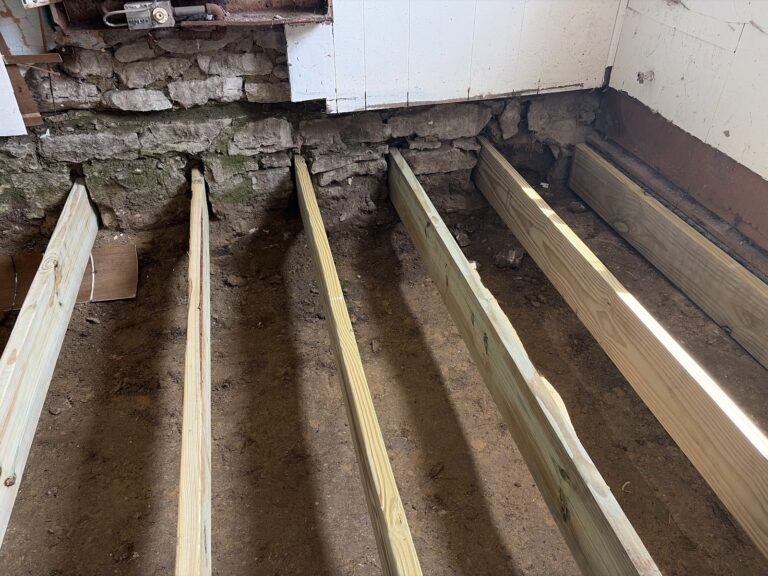 Structural Floor System Rebuilt — Davenport, IowaDavenportA Davenport, Iowa home's sagging floor traced back to a wet crawlspace. See how Behncke removed the failed framing, added a heavy-duty moisture barrie…