
Before You Buy Helical Piers, Find Out If You Actually Need Them
Helical piers can cost homeowners thousands of dollars and, in our experience, are often sold before anyone asks the most important question: why did the foundation move in the first place?
Helical piers are overused in residential foundation repair. That is our position, and we will explain it.
Behncke Construction has been in Quad Cities basements since 1948. We have looked at a lot of settled foundations, and we have looked at a lot of pier proposals that homeowners brought to us for a second opinion. We do not install piers. We fix the drainage so piers are not needed. This page lays out what we have seen, what we believe, and what we think you should do before you sign a pier contract.
We believe helical piers are substantially overused in residential foundation repair, and that many homeowners are sold expensive underpinning systems before simpler causes of movement, particularly drainage and changing soil moisture, have been adequately investigated. We believe many residential helical pier installations could be avoided by identifying and correcting the underlying water or drainage problem first.
To be clear about what this is: it is our professional field opinion, formed over decades of doing this work in the Quad Cities. It is not a published statistic, and we are not aware of a credible study that puts a percentage on it. We would rather tell you plainly what we believe and why than dress an opinion up as data.
Piers make sense when the problem is inadequate bearing and the building’s load genuinely needs to be transferred to deeper competent material. If the underlying problem is primarily drainage or moisture management, you should determine that before underpinning the house.
The soil under the footing cannot carry the house, no matter how dry or well drained it is. The load has to go somewhere deeper. That is a bearing problem, and a pier is built for it.
The soil could carry the house fine if it were not being soaked, washed out, or dried and swollen by water that can be redirected. That is a drainage problem, and it should be identified and corrected before anyone talks about underpinning.
What a helical pier does, and what it does not do
A helical pier is a steel shaft with helix plates on the end. It is screwed into the ground next to your footing until it reaches soil that can carry the load, then a bracket connects it to the foundation. The weight of the house is transferred off the shallow soil and onto the pier. That is a legitimate piece of engineering, and in the right situation it is the right tool.
What a pier can do
When the soil under a footing truly cannot carry the house, a pier bypasses that soil and carries the load to something deeper and more competent.
What a pier cannot do
A pier holds up the foundation. It does nothing about what is happening to the soil around it, and it does not change where the water on your lot goes.
This is what a helical pier installation looks like
Each pier means excavating to the bottom of the footing, driving the shaft, bolting a bracket under the foundation, and backfilling. Multiply that by every pier on the proposal. It is real structural work with a real price, which is exactly why the question of whether you need it deserves an answer first.
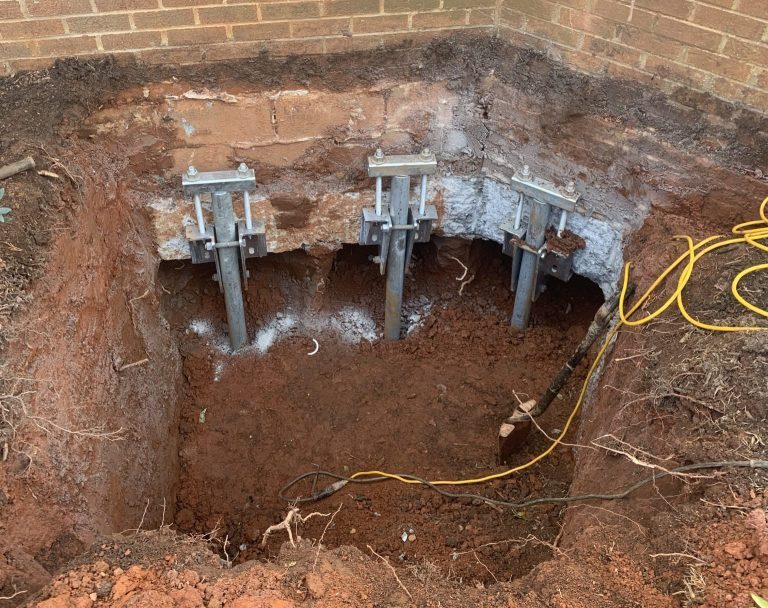
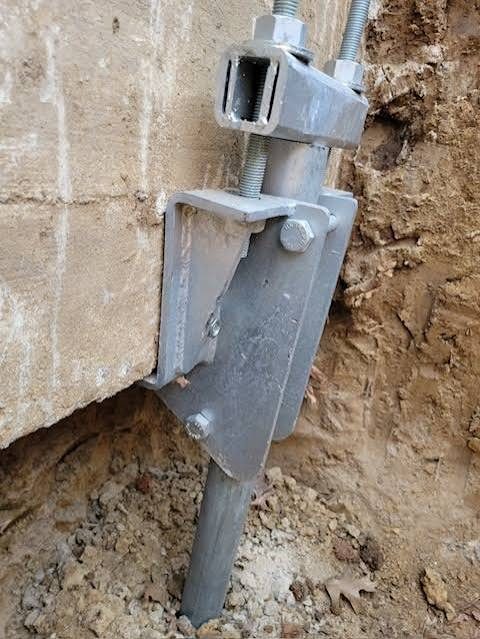
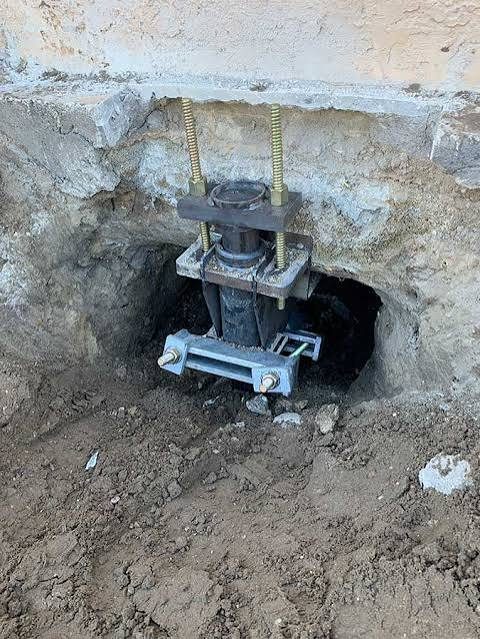
Photos shown for illustration of what a typical helical pier installation involves.
Are we treating the cause or the symptom?
A pier can support a foundation that has moved. That does not automatically explain why it moved.
Foundations settle because the soil under them changes. In the Quad Cities that usually means clay that swells when it is wet and shrinks when it dries. If excessive or changing soil moisture, poor grading, concentrated roof runoff, leaking utilities, erosion, or another correctable site condition caused the movement, installing piers without addressing that condition treats the structural consequence without correcting the underlying site problem. The house is now sitting on steel, and the water is still going exactly where it was going before.
“In our experience, homeowners are too often moved directly from ‘your foundation has settled’ to ‘you need piers.’ We believe an important diagnostic step is being skipped: Why did it settle?”
Changing soil moisture
Clay that cycles between soaked and bone dry moves, and the footing moves with it. A wet spring followed by a drought can do more to a foundation than years of normal weather.
Grading that slopes toward the house
Soil that has settled against the foundation over the years sends surface water straight to the footing. Often this is fixable with fill and a rake, not steel.
Concentrated roof runoff
A downspout dumping at the corner of the house puts hundreds of gallons into a few square feet of soil every storm. Corners are where we see a lot of “settlement.”
Leaking utilities
A cracked sewer lateral or a weeping water service can soften or wash out the soil under a footing for years without anyone noticing.
Erosion and washout
Water moving along the outside of a foundation carries fines with it. Over time the footing is bearing on less than it was built on.
Trees, drain tile, and the rest
Large trees pulling moisture out of clay, a failed or missing footing drain, a sump that never runs. Each one changes the soil, and each one can be corrected.
Before you spend thousands on piers, hire an independent engineer
If you are considering helical piers, push piers, underpinning, or any other expensive and invasive structural repair, Behncke Construction recommends that you get an opinion from an independent licensed professional engineer before you sign a foundation repair contract. Not the engineer the repair company brings along. One you hire, who works for you.
Ask that engineer one specific question, in writing if you can:
“Can this problem be corrected or stabilized through drainage and water management without underpinning the foundation?”
Or, put another way: “Is underpinning actually necessary, or could the movement be stabilized or addressed by correcting drainage, grading, water management, or another underlying condition first?”
If the engineer determines that the structure truly needs to transfer its load to deeper competent bearing material, piers may be entirely appropriate. But that determination should come before the product is sold, not afterward.
Who is being paid to do what
This is not about whether anyone is honest. It is about what each person is being paid to do. A foundation repair salesperson earns money when a repair system is sold. An independent engineer is being paid to evaluate the structure and determine what is actually necessary. Those are two different jobs, and only one of them has “is a repair needed at all?” as the deliverable.
Is paid when a repair system is sold.
The evaluation is usually free, and the recommendation is usually a product the company installs. That is how the business works. It is not an accusation, it is a description of the incentive.
Is paid to tell you what is actually necessary.
The engineer sells nothing but the evaluation. “You do not need underpinning, fix the drainage and monitor it” is a perfectly good answer for them to give, because their fee is the same either way.
An engineer’s evaluation typically costs a few hundred dollars. Against a pier proposal that can run well into five figures, we think it is the best money a homeowner can spend on a settled foundation. We say that knowing the engineer may also tell you that you do not need us either.
How to get an engineer’s opinion that is actually independent
The word “engineer” gets used loosely in this industry. Here is how to make sure the opinion you are paying for is the one you need.
Hire them yourself
Look for a licensed professional engineer (PE) in Iowa or Illinois who does residential structural evaluations. You call them, you pay them, the report is addressed to you.
Ask if they sell repairs
An engineer who is affiliated with, paid by, or referred by a pier installer is not independent for this purpose. Ask directly. A good one will not be offended.
Ask the water question first
Tell them up front: “I want to know whether this can be stabilized through drainage and water management before I consider underpinning.” Then let them look at the whole lot, not just the crack.
Get it in writing
Ask for a written report that says what moved, why they think it moved, whether it is still moving, and what they recommend in what order. Hand that report to any contractor who bids the work, including us.
We do not install piers. We fix the drainage so piers are not needed.
That is the whole business model. When a foundation in the Quad Cities has settled, we find where the water is going, correct the grading, runoff, and drainage that put it there, and stabilize what moved with steel bracing and targeted repairs. In our experience, once the soil stops changing, the foundation stops moving. We have no pier system to sell you, so we have no reason to tell you that you need one.
We are also not going to pretend underpinning is never called for. If an independent engineer looks at your house and determines the footing truly has to be carried to deeper bearing material, that is a sound repair and you should have it done. We will not be the ones installing it, and we will tell you that plainly.
When an engineer may reasonably call for underpinning
Even then, the order matters. The water management should be corrected first or at the same time, or the new piers will be sitting in the same conditions that caused the problem.
In our experience, most of the time installing piers can be avoided.
If that were not the case, we would install them ourselves. We do not, because we believe fixing the drainage problem is the solution most of the time. That is not a sales angle. It is what we have seen in Quad Cities basements for decades, and it is why our first question on every settled foundation is where the water is going.
Questions we hear about helical piers
Do not sign it yet. Hire an independent licensed engineer, hand them the quote, and ask whether the movement could be stabilized by correcting drainage, grading, or water management first. If the engineer agrees piers are needed, you have lost nothing but a few hundred dollars and gained a written basis for the repair. If the engineer does not agree, you may have just saved the cost of the piers. We are also happy to look at the quote and the house and give you our read at no charge.
No. We do not install helical piers, push piers, or any other underpinning system. We fix the drainage and water management that caused the foundation to move, and we stabilize walls with steel bracing and targeted repairs. In our experience, that is what most settled Quad Cities foundations actually need. If an independent engineer determines your house is one of the exceptions that truly requires underpinning, we will tell you so and step aside, but we will still want the water corrected first so the repair is not fighting the same conditions.
Maybe. Plenty of engineers who work with repair companies are competent and honest. The issue is the question they are asked. An engineer brought in by the installer is usually asked to design the pier layout, not to decide whether piers are the right approach at all. You want someone whose only job is the second question, and who is paid the same fee regardless of the answer.
Usually not fully, and that is fine. The goal of correcting the water is to stop the movement, not to reverse it. A foundation that has settled a little and then stopped is a stable foundation. Cracks that opened during the movement can be sealed and the wall braced if needed. What you are avoiding is paying for a lift that the house did not need and that would not have addressed why it settled.
Measure it. Mark the ends of a crack and date it, or have crack monitors installed. Correct the obvious water problems, then watch it through a wet season and a dry one. Active movement across that cycle is real information for an engineer. A crack that opened years ago and has not changed is a different situation than one that is growing, and the two deserve different repairs.
Got a pier quote you are not sure about?
Send it over or tell us what you are seeing. We will look at the house and the water around it and tell you what we think is actually going on. We do not install piers, so we have nothing to gain by telling you that you need them. If the honest answer is “fix the downspouts and watch it,” that is what you will hear. No commissioned salespeople.
Thanks, we’ve got it.
We’ll follow up within one business day to set up your free on-site evaluation.